 Stylino
Are Tissot Watches Good? An Honest Quality Review
You've seen the name on airport duty-free displays and in watch forums where people argue about value. Tissot sits in that peculiar price bracket where you're spending real money (€275 to €2,000 for most models) but you're not quite in "luxury" territory. So what are you actually getting for your euros?
After tracking 619 Tissot references across three retailers that ship to Cyprus on Stylino's Tissot hub, here's an honest breakdown of where this 172-year-old brand delivers and where it falls short.
Brand Heritage: 172 Years of Swiss Watchmaking
Charles-Félicien Tissot and his son Charles-Émile founded the company in 1853 in Le Locle, Switzerland, the same small town that gave its name to one of their most popular collections. That "1853" engraved on the caseback isn't decorative filler. It marks Tissot as one of the oldest continuously operating Swiss watch manufacturers, predating even Omega by 50 years.
Today, Tissot belongs to the Swatch Group, the world's largest watch conglomerate. That corporate backing means access to ETA movements (Swatch Group's movement-manufacturing arm), economies of scale, and a global service network spanning 160 countries. According to Monochrome Watches, the brand exports over 4 million watches annually, generating roughly €1 billion in revenue.
Their motto, "Innovators by Tradition," sounds like marketing copy, but the track record backs it up: first mass-produced pocket watch (1853), first anti-magnetic watch (1929), first plastic watch (1971), and the T-Touch touchscreen watch in 1999.
What "Swiss Made" Actually Means
When you see "Swiss Made" on a Tissot dial, it's not just a sticker. Swiss law requires three things: the movement must be Swiss, final assembly must happen in Switzerland, and at least 60% of manufacturing costs must be incurred domestically.
This matters because every Tissot you buy, from the €275 PR 100 quartz to the €955 chronograph, passes through Swiss quality control. The dial, hands, case assembly, and final regulation all happen under Swiss standards. Compare that to fashion watches at similar prices (Daniel Wellington, MVMT) where "designed in Sweden" means assembled in China with generic Miyota movements.
The practical difference? Tighter tolerances, better finishing on internal components, and a regulated movement that holds its accuracy specification out of the box. You can explore the full range of Swiss-certified Tissot models on Stylino to see what's available at each price tier.
Movement Quality: The Powermatic 80 Advantage
Here's where Tissot genuinely punches above its weight class. The Powermatic 80, Tissot's workhorse automatic movement, delivers an 80-hour power reserve. That's nearly double the industry standard of 38–42 hours found in most Swiss automatics at this price.
What does 80 hours mean in practice? Take your watch off Friday evening, and it's still running Monday morning. No winding, no resetting. For anyone who rotates between two or three watches, that's a real convenience.
The movement exists in three tiers, according to Caliber Corner's technical database:
Standard (Nivachron hairspring): Found in the PR 100, Classic Dream, and entry models. Accuracy: -4/+6 seconds per day. Improved magnetic resistance over older Nivarox hairsprings.
Silicium (silicon hairspring): Used in the Gentleman Powermatic 80 Silicium and select PRX models. Better anti-magnetic properties, longer service intervals, and improved accuracy of approximately -4/+4 seconds per day.
COSC Chronometer: Reserved for the Ballade collection. Certified by the Swiss Official Chronometer Testing Institute to ±5 seconds per day (typically regulated to +1 second). The most accurate movement Tissot offers.
The trade-off for that 80-hour reserve is frequency. The Powermatic 80 beats at 3Hz (21,600 vibrations per hour) instead of the traditional 4Hz. In theory, lower frequency means slightly less smooth seconds-hand sweep and marginally lower positional accuracy. In practice, unless you're timing Olympic races, you won't notice.
Build Quality: What €300–€900 Buys You
Tissot's spec sheet reads impressively for the price point:
Sapphire crystal: Standard on nearly every model above €275. Scratch-resistant, only diamond and tungsten carbide will mark it. Many competitors at this price (Seiko's entry line, Citizen Eco-Drive) use mineral crystal or Hardlex, which scratches more readily.
316L stainless steel: The same surgical-grade steel used by Rolex and Omega. Hypoallergenic, corrosion-resistant, and takes a polish well.
Water resistance: 100 metres on most sports and everyday models. The Seastar line pushes to 300m and 600m. Enough for swimming, snorkelling, and recreational diving off the Cyprus coast without second thoughts.
Finishing: At €400–€700, you'll find brushed and polished surfaces on the same case, applied indices (not printed), and properly bevelled pushers. The PRX's integrated bracelet, for instance, has alternating brushed tops and polished sides that catch light in a way reminiscent of watches costing five times more.
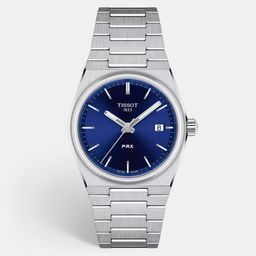
Tissot
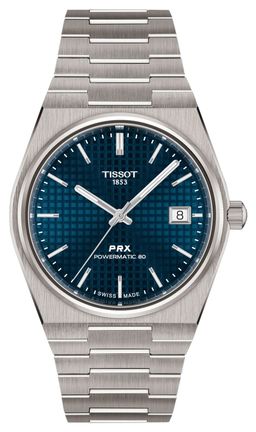
Tissot PRX T137.410.11.041.00 Blue Dial Stainless Steel me n's Wristwatch 40mm
€444.00
Is Tissot Luxury?
No. And pretending otherwise would undermine this review's credibility.
Tissot occupies what the industry calls "accessible Swiss" or "mid-range." The hierarchy runs roughly: Swatch/Flik Flak → Hamilton/Tissot → Longines/Rado → Omega → Breguet. Tissot sits firmly in the second tier, above Japanese competitors like Seiko and Citizen in perceived Swiss prestige, but well below what most people mean when they say "luxury watch."
The price distribution on Stylino's Tissot catalogue tells the story: 263 watches (45% of the catalogue) fall between €300 and €499. The average price is roughly €624. You can spend €4,000 on an 18K gold Tissot, but that's the exception.
Think of Tissot as the Honda Civic of Swiss watches: reliable, well-engineered, excellent value per euro spent, zero pretence about being a Ferrari. If you need help finding the right model by budget, our Tissot buying guide covers every price tier.
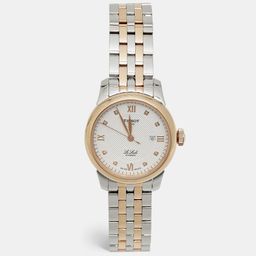
Tissot
Tissot Le Locle T006.207.22.036.00 Silver Dial Two Tone Stainless Steel Diamond Women's Wristwatch 29 mm
€353.00
Where Tissot Excels
Power reserve leadership. At this price, nobody matches the Powermatic 80's 80 hours. Seiko's comparable 6R35 manages 70 hours. Most ETA 2824-based competitors offer 38–42 hours.
Price-to-spec ratio. Sapphire crystal + 80-hour automatic + 100m water resistance + 316L steel for under €500. Try finding that combination elsewhere. You'll end up paying €700+ at Longines or Tag Heuer. You can compare current Tissot prices across all three tracked retailers to find the best deal.
Global service network. With Swatch Group backing, finding an authorized service centre is straightforward in almost any country. In Cyprus, Onnik Time Center in Larnaca handles Swatch Group brands. That matters when you need a gasket replaced or a movement serviced.
Design range. From the retro-modern PRX (which went genuinely viral on TikTok with over 135 million views) to the classical Le Locle to the sporty Seastar diver. Whatever your style preference, there's likely a Tissot that fits it, and at a price that doesn't require a bank loan.
Where Tissot Falls Short
No in-house movement. The Powermatic 80 is based on ETA's C07/2824-2 architecture. It's modified and improved, but it's not designed from scratch by Tissot. Watch enthusiasts who value movement exclusivity will notice. Seiko, at a lower price, designs and manufactures its own movements entirely in-house.
Limited resale value. Buy a Tissot for €700, wear it for three years, and you might sell it for €250–€350. Unlike Rolex or even Omega, there's no secondary-market premium. Tissot watches are tools, not investments.
Less collector cachet. Your watch-collector friend probably won't gasp when you show them a new Tissot. The brand doesn't carry the conversational weight of an Omega Speedmaster or a Grand Seiko. If watch-nerd approval matters to you, this is worth considering.
Finishing ceiling. While good for the price, Tissot's finishing doesn't compare to Longines or Oris at the €800–€1,500 mark. Look closely at handset polishing and movement decoration, and the price gap becomes visible.
The Verdict for Cyprus Buyers
If you're shopping for a Swiss automatic watch under €700 with delivery to Cyprus, Tissot represents one of the strongest propositions available. The 80-hour power reserve alone justifies serious consideration, and the build quality matches or exceeds anything else at this price tier.
Where it makes less sense: if you want collector-grade exclusivity, investment-worthy resale, or bragging rights at a watch meetup. For those priorities, save for an Omega or explore Grand Seiko.
For everyone else (professionals wanting a reliable daily watch, gift buyers seeking quality Swiss heritage without mortgage-level pricing, anyone tired of fashion watches that stop working after 18 months) Tissot delivers honestly on what it promises.
Read next
- Tissot Watches Cyprus — Complete Buying Guide for retailer comparisons and pricing tiers
- Tissot Powermatic 80 Explained (coming soon) for a full movement deep-dive
- Best Tissot Watches for Women (coming soon) for women-specific recommendations
Frequently Asked Questions
Is Tissot a luxury brand?
No. Tissot is classified as "mid-range Swiss" within the Swatch Group hierarchy. It sits above fashion watches and Japanese brands in Swiss prestige, but below Longines, Omega, and other true luxury houses. Think of it as accessible Swiss quality: genuine horological heritage without the luxury markup.
How long do Tissot watches last?
With proper maintenance, a Tissot automatic watch should last decades. The Powermatic 80 movement requires servicing every 3–5 years (cleaning, lubrication, gasket replacement). Quartz models need a battery every 2–3 years. The 316L stainless steel cases and sapphire crystals are highly durable and resist everyday wear.
Is Tissot better than Seiko?
Neither is objectively "better" since they excel at different things. Tissot offers Swiss Made cachet, sapphire crystal as standard, and an industry-leading 80-hour power reserve. Seiko offers fully in-house movements, lower entry prices, and legendary dial craftsmanship (especially on Presage models). Choose Tissot for Swiss heritage and specs; choose Seiko for value and movement exclusivity.
What does 1853 mean on a Tissot watch?
It's the brand's founding year. Charles-Félicien Tissot and his son Charles-Émile established the company in 1853 in Le Locle, Switzerland. The engraving appears on most Tissot casebacks as a heritage marker, indicating over 170 years of continuous Swiss watchmaking.
Are Tissot watches a good investment?
For financial returns, no. Tissot watches depreciate significantly on the secondary market, with 50–65% value loss typical over 3–5 years. They are not collector's items and won't appreciate. However, as a "use value" investment in a reliable, well-built Swiss watch that will serve you daily for decades with minimal maintenance costs, they're excellent.
Ready to see what's available? Browse all 619 Tissot watches on Stylino and compare prices across retailers that ship to Cyprus. With three retailers tracked, a quick check can save you €50–€150 on the exact same reference number.