 Stylino
The Swatch story: how a plastic watch saved the Swiss watch industry
The story of Swatch is the story of an industry nearly destroyed and then rebuilt from a single, radical idea: what if a Swiss watch cost less than dinner? Before Swatch, Swiss watchmaking was collapsing. After Swatch, Switzerland owned the world's largest watch group. This is how it happened — and why, in 2026, you can still buy a Swiss-made watch from €60 on Swatch.
The quartz crisis: Switzerland's near-death experience
In the early 1970s, Switzerland controlled over 50% of the global watch market by revenue and nearly 30% by volume. Swiss watchmakers employed over 90,000 people. The industry was built on precision mechanical movements — tiny engineering marvels of springs, gears, and escapements, perfected over centuries.
Then Japan changed everything. The quartz crisis began when Seiko introduced the Astron in 1969 — the world's first commercial quartz watch. By the mid-1970s, Japanese manufacturers (Seiko, Citizen, Casio) were flooding the market with quartz watches that kept better time than any mechanical movement and cost a fraction of the price.
The numbers were devastating: by 1983, Switzerland's share of global watch production had collapsed from 50% to 15%. Employment in the Swiss watch industry halved. Hundreds of manufacturers closed. The industry that had defined Swiss precision for 500 years was dying.
The response: 51 parts instead of 91
In 1978, Ernst Thomke — the newly appointed CEO of ETA SA, Switzerland's largest movement manufacturer — gave two engineers an impossible brief: design a Swiss quartz watch that could be manufactured cheaply enough to compete with Japan on price.
Jacques Müller and Elmar Mock delivered something radical. Their design used just 51 components instead of the 91 found in a typical quartz watch. The movement was built directly into the case — no separate module that could be removed and serviced. The case was injection-moulded plastic, sealed ultrasonically. Assembly was entirely automated.
The result: a Swiss-made quartz watch that could be produced for roughly $3 and sold for $40. It was, in every sense, an industrial revolution in miniature.
1983: the birth of Swatch
The first Swatch collection launched on 1 March 1983 in Zürich. The name — a contraction of "Second Watch" — revealed the positioning: this wasn't meant to replace your dress watch. It was a fun, colourful, disposable accessory you'd own alongside your serious timepiece.
The original 12 models came in bold colours with graphic dials, priced at 50 Swiss francs (approximately $39 at the time). According to Swatch's documented history, the company sold over one million watches in its first year.
What made Swatch different from other cheap quartz watches:
- Swiss Made: every Swatch carried the "Swiss Made" stamp, associating the fun plastic object with 500 years of horological credibility
- Design-led: new collections dropped seasonally, like fashion — not annually, like traditional watchmakers
- Collectible: limited editions and artist collaborations turned watches into objects people collected, not just wore
- Affordable luxury positioning: cheap to buy, but never marketed as "cheap" — always as "accessible"
The marketing genius: watches as art
Swatch understood something its Swiss predecessors never did: for most people, a watch is jewellery, not a precision instrument. The brand leaned into this completely.
Artist collaborations began almost immediately. Keith Haring designed a Swatch in 1985. Kiki Picasso, Mimmo Paladino, and dozens more followed. Limited editions sold out instantly and traded on secondary markets for multiples of retail price.
By the late 1980s, Swatch had created an entirely new category: the watch-as-fashion-accessory. People owned five, ten, twenty Swatch watches and rotated them with outfits. The concept seems obvious now — but before Swatch, watches were serious objects you owned one of and serviced every five years.
Nicolas Hayek and the Swatch Group empire
The rescue of Swatch is inseparable from Nicolas Hayek, a Lebanese-born Swiss business consultant hired in 1983 to advise on the restructuring of Switzerland's watch industry. His recommendation: don't sell off the failing companies. Merge them.
In 1983, the two largest Swiss watch conglomerates (ASUAG and SSIH) merged to form SMH. Hayek became CEO in 1986 and chairman in 1998. Under his leadership, the group — renamed The Swatch Group in 1998 — grew into the world's largest watch company.
The genius was using Swatch's volume and profitability to subsidise and rebuild the premium brands. Swatch profits funded the renaissance of Omega, Longines, Tissot, Breguet, and Blancpain. According to Swatch Group's corporate profile, the group today owns 17 watch brands spanning from €60 (Swatch) to €200,000+ (Breguet).
The Swiss watch industry's survival is directly attributable to the little plastic watch that cost $40. Without Swatch's cash flow in the 1980s, many of today's most prestigious Swiss brands would not exist.
Key milestones: from Internet Time to MoonSwatch
1994 — Irony: the first metal-cased Swatch, breaking the "plastic only" rule and moving the brand upmarket.
1997 — Skin: an ultra-thin quartz watch that proved Swatch could innovate on form, not just colour. At 3.9mm thick, it remains one of the thinnest watches available at any price.
1998 — Swatch Internet Time: Swatch proposed dividing the day into 1,000 ".beats" with no time zones — a visionary (if ultimately unsuccessful) attempt to create a universal internet time standard.
2013 — Sistem51: a fully machine-assembled mechanical movement with just 51 parts. No human hand touches the movement during production. It proved automatic watchmaking could be democratised — a genuine mechanical Swiss watch for under €200 at launch. Hodinkee's technical review called it "a revolution in mechanical watchmaking."
2020 — Bioceramic: a proprietary material blending bio-sourced plastic with ceramic. Lighter than steel, harder than plastic, and sustainable in sourcing — Swatch's answer to the luxury watch industry's materials arms race.
2022 — MoonSwatch: the collaboration with Omega that broke the internet. Eleven Bioceramic watches inspired by Omega's Moonwatch, priced at approximately €250. Queues wrapped around buildings. Two years later, availability has normalised and the watches sit in the premium Swatch tier.
Swatch in 2026: still Swiss, still €60, still the world's most accessible Swiss watch
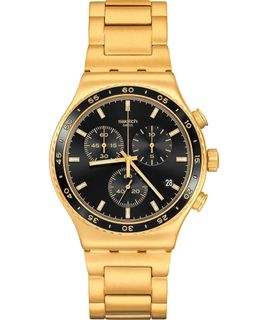
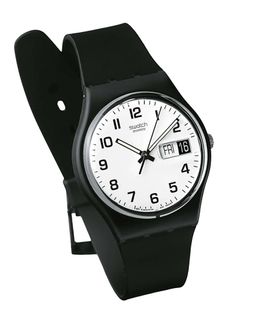
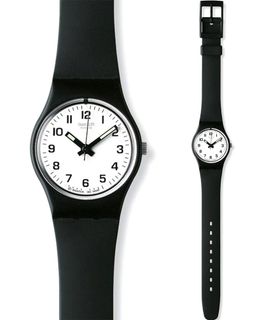
Four decades after launch, Swatch's formula remains unchanged in its essentials: Swiss Made, affordable, design-driven, and collectible. The price range — €60 to €270 — spans from a simple quartz Gent to a Bioceramic automatic, but even the top of the range costs less than the entry point of any other Swiss watch brand.
On Stylino, you can browse 570 Swatch models from Eleftheriou Online — one of the established watch retailers that ships to Cyprus. Every model is tracked for price history, and you can set alerts for price drops on any piece that catches your eye.
The brand that saved the Swiss watch industry remains the easiest way into Swiss watchmaking: a €60 watch with the same national origin stamp as a €50,000 Omega.
Frequently asked questions
Read next
- Best Swatch watches in Cyprus 2026: from €60 classics to €270 Bioceramic
- MoonSwatch guide: is it worth the hype?
- Swatch Sistem51: the cheapest Swiss mechanical watch
Explore the full Swatch collection on Stylino
From €60 classics to €270 Bioceramic — all 570 models, tracked for price history, with alerts for drops. Visit the Swatch and find your next Swiss watch, delivered to Cyprus.