 Stylino
Tissot PRX Guide — The Watch That Broke the Internet
Sometime around late 2020, a Swiss watch priced under €700 started getting more screen time on TikTok than Rolexes and Pateks combined. The Tissot PRX, a revival of a mostly forgotten 1978 design, racked up over 135 million views and sold out repeatedly at authorized dealers worldwide. According to GQ, it became one of the most-discussed watches of the decade online.
The hype has since cooled into something more useful: genuine appreciation. The PRX isn't just a social media moment. It's arguably the most thoughtfully designed Swiss watch you can buy under €1,000. Here's what you need to know if you're considering one with delivery to Cyprus.
From Forgotten '78 Original to TikTok Sensation
The name isn't random marketing. PRX stands for Precise, Robust, and X for the sapphire crystal. Tissot launched the original in 1978 as a slim, bracelet-integrated quartz watch, years before the integrated-bracelet silhouette became synonymous with five-figure luxury pieces like the Audemars Piguet Royal Oak.
By the 1990s, the PRX had vanished from catalogs. It survived only in vintage markets and collector forums, mostly as a footnote.
September 2020 changed that. Tissot quietly reissued a quartz PRX at around €350. Clean design, solid specs, sensible price. The watch community noticed but didn't lose its collective mind. That happened six months later, in March 2021, when the Powermatic 80 automatic version arrived at roughly €650. An 80-hour power reserve Swiss automatic in an integrated bracelet case, priced hundreds below the competition.
Then TikTok creators started calling it the "affordable Royal Oak," a comparison to Audemars Piguet's €30,000+ icon that Tissot probably never planned for. The rest, as they say, is algorithm history.
Why the PRX Actually Went Viral
Strip away the hype and three things made the PRX explode.
The integrated bracelet. The case and bracelet flow into each other as a single visual line, a design language pioneered by Gérald Genta's Royal Oak in 1972 and Patek Philippe's Nautilus in 1976. Both of those watches now sell for €30,000 to €150,000+. The PRX delivers the same silhouette starting at roughly €350. That's not "affordable luxury." That's a different price universe entirely.
The retro-modern balance. Flat sapphire crystal, slightly cushion-shaped case, polished chamfers catching light along the edges. It looks like something a well-dressed character in a 1970s film would wear, except the movement inside is thoroughly modern. That tension between old and new photographs extremely well, which matters more than most watch brands want to admit.
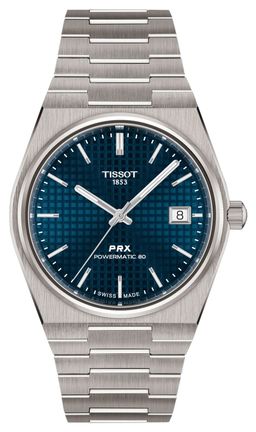
Color variety. Tissot understood that the TikTok generation treats watches like sneakers: you want options. Blue sunburst, forest green, waffle-textured black, ice blue, champagne gold PVD. Walk into a Tissot display in Nicosia or Limassol and the dial variety alone draws your eye before you even check a price tag.
PRX Lineup Breakdown
The PRX family is broader than most people realize. Here's what exists across the current global range:
| Variant | Case Size | Movement | Approx. Price Range |
|---|---|---|---|
| PRX Quartz | 35mm / 40mm | Swiss quartz | €350–€450 |
| PRX Powermatic 80 | 35mm / 40mm | Automatic, 80-hr reserve | €650–€750 |
| PRX Automatic Chronograph | 42mm | Valjoux-based auto chrono | €900–€1,100 |
| PRX 18K Gold | 40mm | Powermatic 80 | €3,500+ |
| PRX Digital | 35mm / 40mm | Quartz digital | €350–€400 |
What's on Stylino right now: the Tissot catalog tracks 619 references across three retailers that ship to Cyprus (First Class Watches, Eleftheriou Online, and The Luxury Closet). PRX availability fluctuates because popular references sell out fast. At the time of writing, PRX models start from around €955 for automatic chronograph variants. For the quartz and standard Powermatic 80 models, set a Stylino price alert since stock replenishes regularly.
Tissot PRX 35mm vs 40mm: Which Size?
This is the question that fills Reddit threads and watch forums. The answer depends on your wrist, but a few specifics help.
35mm PRX:
- Lug-to-lug span: 40.8mm
- Thickness: 10.9mm (quartz) / 10.9mm (Powermatic)
- Best for wrists under 17cm circumference
- Closer to the 1978 original proportions
- According to Hodinkee's hands-on review, the 35mm "wears larger than the number suggests" thanks to the integrated bracelet adding visual width
40mm PRX:
- Lug-to-lug span: 47.4mm
- Thickness: 10.9mm (quartz) / 11.3mm (Powermatic)
- Best for wrists 17cm and above
- The proportions most buyers picture when they think "PRX"
- As Monochrome Watches notes in their comparison, the 40mm's extra millimetres make the dial details (sunburst finish, applied indices) more legible
Here's something most guides won't tell you: the integrated bracelet on both sizes doesn't articulate at the first link. That means the watch sits on a rigid platform extending past the lugs. On a small wrist, the 40mm can feel like it's perching rather than wrapping. Try both on if you possibly can. If ordering online to Cyprus without trying first, measure your wrist and lean toward the 35mm if you're anywhere near the boundary.
Quartz vs Powermatic 80: Which PRX Movement?
The roughly €300 gap between quartz and automatic PRX isn't just about bragging rights. Here's what you're actually paying for.
Quartz PRX (~€350–€450): Dead-accurate timekeeping (±15 seconds per month), battery lasts 3–4 years, thinner profile on the 35mm. You never set the time unless you change the battery. For someone who wants the PRX look without fussing over watches as objects, this is the rational pick.
Powermatic 80 PRX (~€650–€750): 80-hour power reserve means you can leave it on the nightstand Friday evening and pick it up Monday morning still running. The sweeping seconds hand is genuinely mesmerizing at arm's length. According to Caliber Corner, the movement beats at 21,600 vibrations per hour (3Hz), slightly slower than the industry-standard 4Hz. That's the trade-off for the marathon reserve.
Honestly? The quartz PRX is underrated. Most people online push the Powermatic 80 because "automatic = real watch" in forum culture, but the quartz version is lighter, slimmer, cheaper, and keeps better time. If you're buying a PRX purely for the design and don't care about mechanical romance, save the €300.
Best Dial Colors (and Why It Matters)
Dial color on the PRX isn't cosmetic. The sunburst finishing Tissot uses means each color shifts dramatically depending on light angle. In the Mediterranean sun of a Larnaca afternoon, the blue sunburst goes from near-black indoors to electric blue outdoors. That's not something you see in photographs.
Blue sunburst: The bestseller. Deep navy in shade, vivid blue in sunlight. Pairs with everything from a linen shirt to a suit jacket. This is the dial that went viral.
Green: The trend-forward pick. Darker than you expect, almost black in low light. Green watches had a massive surge in 2022–2024, and the PRX green is one of the best at this price.
Black: The safe choice, and safe for good reason. Black sunburst with applied silver indices reads as subtly sporty, never flashy. Works with any outfit.
Champagne gold PVD: The dressy variant. Gold-tone case and bracelet with a warm champagne dial. Looks like a €2,000 watch on the wrist. Not everyone can pull it off, but if you can, it's a statement.
Read next
- Our Tissot Watches Cyprus — Complete Buying Guide covers where to buy, full price tiers, and retailer comparisons
- Our honest Tissot quality review breaks down the Powermatic 80 movement, build quality, and where Tissot falls short
Frequently Asked Questions
Is the Tissot PRX a copy of the Royal Oak?
No. The original PRX debuted in 1978, six years after the Audemars Piguet Royal Oak (1972), and they share the integrated-bracelet concept rather than specific design elements. Both were responses to the quartz crisis, which pushed Swiss brands toward thinner, bracelet-forward designs. The PRX has its own distinct cushion-shaped case, flat crystal, and proportions.
Should I get the 35mm or 40mm PRX?
Measure your wrist. Under 17cm circumference, the 35mm typically looks better because the integrated bracelet adds visual width. Over 17cm, the 40mm fills the wrist more naturally. The 35mm is also closer to the 1978 original's proportions, which gives it an authentic vintage feel that the 40mm doesn't quite match.
Is the PRX Powermatic 80 worth the upgrade over quartz?
It depends on what you value. The Powermatic 80 gives you an 80-hour power reserve and the tactile satisfaction of a mechanical movement. The quartz version is thinner, lighter, more accurate, and €300 cheaper. If the mechanical aspect doesn't excite you, the quartz is the smarter buy. If the sweeping seconds hand and winding ritual appeal, the automatic justifies its premium.
Can I swim with a Tissot PRX?
Yes. All PRX models carry a 100-metre water resistance rating, which comfortably covers swimming, pool use, and snorkelling. Avoid using the chronograph pushers underwater on the Chronograph variant. After saltwater exposure on the Cyprus coast, rinse with fresh water and dry the bracelet to prevent mineral buildup.
Why is the PRX so popular on TikTok?
Three factors: the integrated bracelet photographs and films exceptionally well, the price lets younger buyers actually purchase it (unlike the luxury icons it echoes), and the color variety gives creators visual content. Over 135 million TikTok views have been tagged with PRX-related content, making it the most viral Swiss watch of the 2020s.
Ready to compare? Browse all Tissot watches on Stylino and set price alerts for PRX models. With three retailers tracked that ship to Cyprus, a quick check can save you real money on the exact reference you want. And if you're still deciding between collections, our Tissot hub page lets you filter by price, gender, and retailer.