 Stylino
Tissot Seastar Dive Watch Guide
Living on an island changes how you think about watches. Not philosophically, but practically. You're ten minutes from a beach at any point in Cyprus. A harbour-side lunch in Paphos can turn into an impromptu swim. Your colleague invites you on a boat trip off Protaras this Saturday morning. The question isn't whether you'll get your watch wet; it's when.
Most dress watches and fashion pieces survive a splash. Actual swimming, snorkelling, salt water exposure day after day? That needs something built for it. The Tissot Seastar line exists precisely for this: Swiss-made dive watches that handle Mediterranean life without costing Mediterranean-yacht money. Starting from around €510 with delivery to Cyprus, they sit in a price bracket that makes daily wear feel guilt-free rather than nerve-wracking.
Why a Dive Watch Makes Sense for Cyprus
Let's be honest about what "dive watch" means in practice. Fewer than 2% of dive watch owners actually dive. The rest of us want a watch that shrugs off pools, beaches, boat spray, and the occasional shower without a second thought. In Cyprus, where summer stretches from April to November and beach culture is woven into weekend routines, water resistance isn't a spec-sheet luxury. It's basic utility.
A dive watch also solves the durability question. Sapphire crystal, screw-down crown, solid bracelet: these are designed to survive tool use, not just compliment a blazer. The unidirectional rotating bezel functions as a low-tech timer for grilling, parking, or (yes, theoretically) decompression stops. All of this in a package that looks muscular enough for a barbecue in Ayia Napa and refined enough to avoid raised eyebrows at a Nicosia business dinner.
Compare that to dressing up a Tissot Le Locle for a day that might involve water. You'd worry. With a Seastar, you don't.
The Seastar Lineup
Tissot organises its dive watches into two distinct tiers. Understanding the difference saves you from overspending on capability you'll never use.
Seastar 1000 (300m Water Resistance)
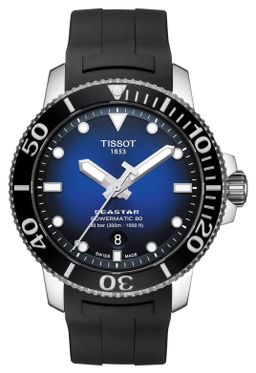
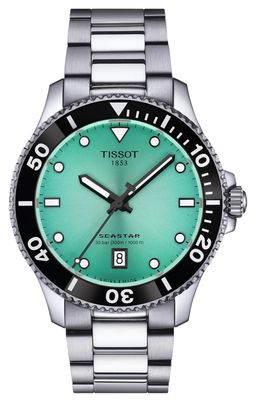
The Seastar 1000 is the workhorse of the line. 300 metres of water resistance, a unidirectional ceramic bezel with luminous pip at 12, and a helium escape valve on higher-spec models. According to Tissot's official site, the Seastar 1000 meets ISO 6425 dive watch standards, meaning it's been tested to function at depth, not merely survive static pressure in a laboratory.
The 40mm case wears comfortably on most wrists. That's notably smaller than competitors like the Seiko Prospex line (typically 43–45mm) and the 42mm Tudor Pelagos. For a diver that doesn't dominate your wrist, the Seastar 1000's proportions are hard to beat in this price bracket.
Movement options split between Swiss quartz (including chronograph variants) and the Powermatic 80 automatic with its 80-hour power reserve. More on that choice below.
Seastar 2000 Professional (600m Water Resistance)
For those who want the full professional-spec dive tool, the Seastar 2000 Professional pushes to 600 metres. According to Tissot, the 2026 edition introduces a redesigned case with sharper lugs, improved lume application on indices, and a new crown guard profile. The helium escape valve is standard on all 2000 Professional variants.
At 46mm and roughly 15mm thick, this is unambiguously a tool watch. It doesn't pretend to be versatile. You buy this if you actually dive, if you love the aesthetic of a serious instrument, or if you simply want the most capable Tissot available. On Stylino, the Seastar 2000 Professional sits around €1,050, still a fraction of what Omega charges for the Seamaster 300M (€5,000+).
Key Specs Comparison
| Feature | Seastar 1000 (40mm) | Seastar 2000 Pro (46mm) | Chrono XL Sport |
|---|---|---|---|
| Water resistance | 300m | 600m | 100m |
| Bezel | Ceramic, unidirectional | Ceramic, unidirectional | Fixed tachymeter |
| Movement | Powermatic 80 / Quartz | Powermatic 80 | Quartz chronograph |
| Power reserve | 80 hrs (auto) / 3-yr battery | 80 hrs | 3-year battery |
| Case material | 316L steel | 316L steel | 316L steel |
| Crystal | Sapphire | Sapphire | Sapphire |
| Approx. price (Cyprus) | €510–€595 | €1,050 | €415–€465 |
PR 100 and Chrono XL: The 100m Sporty Alternatives
Not everyone needs 300 metres. If your water exposure is limited to swimming pools, beach holidays, and unexpected rain, 100 metres of water resistance handles all of it comfortably. Two Tissot collections deliver sport-watch aesthetics with 100m ratings at lower price points.
The PR 100 offers clean, sporty lines in a 40mm case. Think of it as the collection for people who want a reliable daily watch that doesn't look like it's preparing for an expedition. Quartz and automatic options exist, priced from roughly €300 to €450.
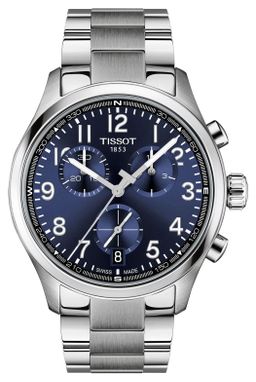
The Chrono XL goes bolder. At 45mm with chronograph complications and a sportier dial layout, it's a statement piece. At €415–€465 on Stylino, it works for larger wrists or anyone who loves the look of sub-dials and tachymeter markings.
How Much Water Resistance Do You Actually Need?
This is where marketing and reality diverge. Brands love printing big depth ratings on dials, but here's what each rating actually means for daily life:
30m (3 ATM): Survives hand washing. That's it. Don't swim with it, don't shower with it. This is essentially splash-proof.
50m (5 ATM): Brief swimming is fine. No diving, no high-pressure water (shower jets can exceed the static pressure rating due to force concentration on the crown and pushers).
100m (10 ATM): Swimming, snorkelling, surface water sports. The sweet spot for casual Mediterranean life. Every pool, every beach, no stress.
200–300m (20–30 ATM): Recreational scuba diving. The Seastar 1000 at 300m handles anything short of professional saturation diving. If you snorkel in Akamas or dive the Zenobia wreck off Larnaca, this is your range.
600m+ (60 ATM): Professional saturation diving. The Seastar 2000 territory. Unless you're a commercial diver or deep-wreck explorer, this is bragging rights and peace of mind in equal measure.
Quartz Chronograph vs Automatic: Choosing Your Seastar Movement
The Seastar line offers both movement types, and the right choice depends on what you value.
Quartz chronograph Seastar (~€510–€595): Chronograph function lets you time dives, intervals, or anything else with a start-stop-reset sequence. Dead-accurate timekeeping. No winding, no setting the time if you leave it in a drawer for a week. The pragmatic choice for actual divers who want reliable instrumentation without fussing over automatic quirks.
Powermatic 80 automatic Seastar (~€510–€595): The 80-hour power reserve means a full long weekend off the wrist without stopping. The sweeping seconds hand gives that mechanical soul that watch enthusiasts love. According to Hodinkee's dive watch buying guide, modern automatic dive watches are perfectly reliable for recreational diving. The old advice about needing quartz precision underwater hasn't been relevant for decades.
If you're buying the Seastar primarily as a daily wearer that happens to be water-ready, the automatic adds character. If you're buying it as a functional dive tool where you'll use the chronograph for timing bottom time, the quartz chrono is more practical. Either way, the 300m water resistance is identical.
Buying a Seastar with Delivery to Cyprus
Three retailers on Stylino's Tissot currently stock Seastar models with shipping to Cyprus. First Class Watches carries the broadest Tissot sport selection, with Seastar 1000 references starting around €510. Eleftheriou Online stocks selected references at competitive prices. Pricing on the same reference can vary by €50–€100 between retailers, so comparing before buying isn't optional. It's basic financial hygiene.
For hands-on try-before-you-buy, Onnik Time Center in Larnaca is an authorized Swatch Group dealer and typically carries Seastar models. ORA Cyprus in Nicosia may also stock selected references. But if you already know what you want, online ordering through retailers tracked on Stylino often delivers better prices with the convenience of home delivery.
Can I swim with a Tissot Seastar?
Yes, comfortably. The Seastar 1000 is rated to 300 metres and meets ISO 6425 dive watch standards. Swimming, snorkelling, and recreational diving are all well within its capability. The screw-down crown and caseback ensure water stays out during normal water activities.
Is the Tissot Seastar as good as a Seiko Prospex?
They're different tools. The Seastar uses a Swiss Powermatic 80 movement with 80-hour reserve and sapphire crystal as standard. The Seiko Prospex uses Seiko's in-house 6R35 with 70-hour reserve but typically ships with Hardlex mineral crystal. The Seastar is slightly more refined; the Prospex is more rugged. Both are excellent dive watches.
What is the difference between Seastar 1000 and 2000?
Water resistance (300m vs 600m), case size (40mm vs 46mm), and positioning. The 1000 is an everyday dive watch that doubles as a daily wearer. The 2000 Professional is a full tool watch for serious diving or collectors who want maximum spec. The 1000 is the better choice for 95% of buyers.
Does Tissot make a Submariner alternative?
The Seastar 1000 occupies the same market position as the Rolex Submariner: a 300m-rated dive watch with ceramic bezel, automatic movement, and steel bracelet. The difference is price. A Submariner costs €9,000+. The Seastar 1000 starts around €510. It's not a copy; it's the Swiss-made alternative at a rational price point.
Read next
- our complete Tissot buying guide for Cyprus covering all collections, price tiers, and where to buy
- our Tissot PRX guide if you prefer integrated bracelet style over dive-tool aesthetics
- our Tissot Le Locle & dress watches guide, the opposite end of the spectrum from a Seastar
Browse all 619 Tissot watches, including every Seastar reference currently available, on the Tissot hub on Stylino. Set a price alert for any model and we'll notify you the moment a better deal appears.