 Stylino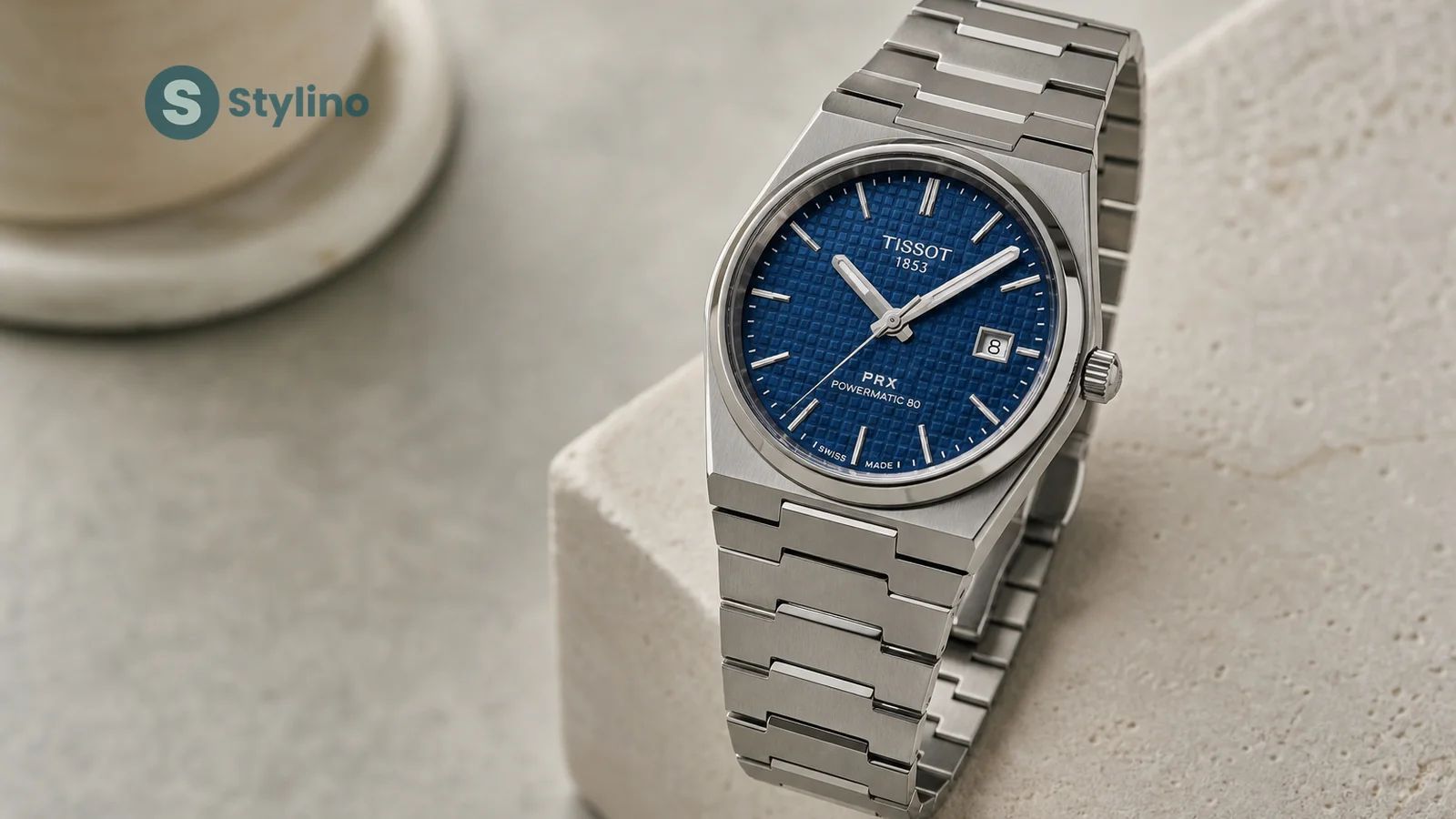
Tissot Powermatic 80 Explained — A Complete Movement Guide
You're looking at two Tissot watches on a screen. Same case. Same dial colour. Same bracelet. One costs €350, the other €650. The price gap comes down to what's ticking inside: quartz crystal versus a mechanical heart called the Powermatic 80. Understanding this movement is the single best way to decide which Tissot deserves your money.
The Powermatic 80 is Tissot's flagship automatic movement, and it shows up in nearly every collection from the PRX to the Le Locle to the Gentleman. It's also one of the most misunderstood movements in the Swiss mid-range. People see "80-hour power reserve" on the spec sheet and assume it's marketing fluff. It isn't. But there are trade-offs worth knowing about before you commit.
What Is an Automatic Watch?
An automatic watch runs on mechanical energy, not a battery. Inside the case sits a tiny rotor, a semicircular weight that spins when your wrist moves. That spin winds a coiled mainspring, which stores energy like a compressed spring in a toy car. As the mainspring slowly unwinds, it drives a gear train that moves the hands around the dial.
No battery. No electronics. Just physics.
The catch: stop wearing it for long enough and the mainspring unwinds completely. The watch stops. You pick it up, give it a shake, set the time, and it starts again. How long a watch runs after you take it off depends on power reserve. Most Swiss automatics store 38 to 42 hours of energy. The Powermatic 80 stores 80.
The Powermatic 80: What It Actually Is
Tissot announced the Powermatic 80 at Baselworld 2012. It's based on the ETA C07.111, itself a descendant of the ETA 2824-2, one of the most widely used Swiss automatic calibres ever produced. According to Caliber Corner, the C07.111 runs at 21,600 vibrations per hour (3 Hz), carries 23 jewels, and measures 25.6mm in diameter with a height of 4.6mm. Those aren't numbers you need to memorise, but they explain why the movement fits inside so many different Tissot case shapes.
The Swatch Group (Tissot's parent company) developed the Powermatic 80 to give their mid-range brands a genuine competitive edge. Before 2012, a buyer choosing between a Tissot and a similarly priced Seiko or Citizen would compare finishing, dial design, and bracelet quality. Power reserve was roughly identical across brands. The Powermatic 80 changed that equation overnight.
Why 80 Hours Matters in Practice
Eighty hours translates to three full days and then some. Take your watch off Friday evening, leave it on the nightstand all weekend, and it'll still be running Monday morning with time to spare. That's the practical promise, and Tissot delivers on it.
With a standard 42-hour movement, missing a single day means resetting time and date. That gets tedious fast, especially for people who rotate between watches. If you own two or three pieces and swap daily, a conventional automatic dies during the rotation. The Powermatic 80 gives you enough runway to switch watches for a day and come back to a running timepiece.
Here in Nicosia, I know a jeweller who tells customers the same thing: "If you're only buying one watch, the power reserve doesn't matter because you'll wear it every day. If you'll ever own a second watch, you want the 80 hours." He's right. The second-watch scenario is where the Powermatic 80 earns its keep.
Tissot
Tissot PRX Powermatic 80 T137.407.11.041.00 Blue Dial Stainless Steel Men's Wristwatch 40 mm
€693.00
How Tissot Achieves 80 Hours (and What It Costs You)
There's no magic. The Powermatic 80 doubles the power reserve through two engineering choices.
Reduced beat rate. Most Swiss automatics run at 4 Hz (28,800 vibrations per hour). The Powermatic 80 runs at 3 Hz (21,600 vph). Fewer vibrations means the mainspring unwinds more slowly, stretching the energy across more hours. According to Caliber Corner, this is the same frequency used in many vintage movements from the 1960s and 70s, so it's proven technology rather than experimental.
Optimized mainspring. Tissot uses a longer, thinner Nivachron alloy mainspring that stores more energy per unit volume. The alloy is also anti-magnetic, which is a bonus.
The trade-off? Accuracy. A 4 Hz movement tracks time more precisely because each "tick" covers a smaller arc of the balance wheel. At 3 Hz, each tick covers a larger arc, which makes the movement slightly more susceptible to positional errors. In practice, Tissot rates the standard Powermatic 80 at -4/+6 seconds per day. You might gain or lose a minute per week. Most people never notice.
Three Tiers of Powermatic 80
Not all Powermatic 80 movements are identical. Tissot offers three grades, and the differences matter if you care about long-term accuracy or magnetic resistance.
Standard (Nivachron hairspring). This is the base tier. The Nivachron hairspring offers good antimagnetic properties (resistant up to ~15,000 A/m) and is the default in most Powermatic 80 models. Accuracy: -4/+6 seconds per day. You'll find it in the PRX quartz-priced automatics, the Classic Dream Powermatic 80, and entry-level PR 100 autos.
Silicium (silicon hairspring). The silicon hairspring doesn't respond to magnetic fields at all, which means your watch won't gain or lose seconds if you leave it next to your phone or laptop speakers. Silicon also has a more consistent thermal expansion, so accuracy improves. Tissot rates Silicium models at -4/+6 s/day officially, but independent reviewers consistently report better real-world performance. You'll find it in the Gentleman Powermatic 80 Silicium and select PRX Powermatic 80 models. Look for "Silicium" printed on the dial or case back.
COSC chronometer-certified. The top tier. COSC (Contrôle Officiel Suisse des Chronomètres) is an independent Swiss testing body that certifies individual movements against strict accuracy standards: -4/+6 seconds per day across multiple positions and temperatures. Only the Tissot Ballade carries COSC certification (featured alongside other dress watches in our Le Locle & dress watches guide). According to Tissot, the Ballade is regulated to approximately +1 s/day, far tighter than the official COSC limits. If raw accuracy matters more to you than design or brand recognition, the Ballade is quietly the best movement in Tissot's entire catalogue.
Tissot
Tissot Gentleman T127.407.11.051.00 Black Dial Stainless Steel Men's Wristwatch 40 mm
€774.00
Which Tissot Models Use Which Tier
| Tier | Hairspring | Accuracy | Key models |
|---|---|---|---|
| Standard | Nivachron | -4/+6 s/day | Classic Dream, PR 100, Everytime Swissmatic (uses Swissmatic, see below) |
| Elaborated | Nivachron (higher finishing) | -4/+6 s/day | PRX Powermatic 80, Le Locle Powermatic 80 |
| Silicium | Silicon | -4/+6 s/day (tighter in practice) | Gentleman Powermatic 80 Silicium, select PRX |
| COSC | Silicon + certified | -4/+6 s/day (regulated to ~+1) | Ballade |
The tier isn't always obvious from the product name. Quick shortcut: if the model says "Silicium" anywhere, it uses the silicon hairspring. If it says "COSC" or "Chronomètre," it's the certified top tier. Everything else is Standard or Elaborated grade.
Powermatic 80 vs Swissmatic
The Swissmatic is Tissot's budget automatic, and it causes confusion because it also offers an impressive 72-hour power reserve. So why does the Powermatic 80 cost more?
The Swissmatic (calibre ETA C15.111) is manufactured using heavily automated production lines, which reduces per-unit cost. It runs at 3 Hz like the Powermatic 80, but uses lower-grade finishing and a simpler regulation approach. The biggest practical difference: the Swissmatic is designed as a non-serviceable movement. When it eventually wears out (typically after 10 to 15 years), you replace the entire module rather than having a watchmaker disassemble, clean, and reassemble it.
The Powermatic 80, by contrast, is fully serviceable. A qualified watchmaker can take it apart, replace worn components, re-oil the jewels, and regulate it back to factory specs. If you plan to keep your watch for decades, serviceability is worth the premium. If you see it as a 10-year consumer product, the Swissmatic saves money without meaningful compromise during its useful life.
Models using Swissmatic include the Gentleman Swissmatic, Everytime Swissmatic, and PR 100 Swissmatic. The name makes it easy to identify.
Quartz vs Automatic: When to Skip the Powermatic 80
Automatic movements carry romance. Quartz movements carry accuracy. Here's a blunt assessment.
Choose quartz if: you hate resetting the time, you want accuracy within ±15 seconds per month (versus per week for the Powermatic 80), you prefer a thinner watch, or you want to spend less. A quartz PRX starts around €350 on retailers that ship to Cyprus via the Tissot hub on Stylino versus €650 for the Powermatic 80. That's €300 you could put toward a second watch.
Choose automatic if: you appreciate mechanical craftsmanship, you want a watch that can theoretically last a lifetime with proper servicing, or you simply enjoy knowing that no battery is involved. There's a satisfaction to wearing something that runs on your own movement. No quartz crystal can replicate that feeling, no matter how accurate it is.
I'll tell you something that watch forums won't: most people can't tell the difference on the wrist. The sweep of the seconds hand is smoother on an automatic (8 steps per second versus 1 tick per second on quartz), and that matters to enthusiasts. But in daily wear? Both keep time well enough. The choice is emotional as much as rational. That's fine. Watches are emotional purchases.
What does Powermatic 80 mean?
Powermatic 80 is the name Tissot gives to its family of automatic movements with an 80-hour power reserve. The "80" refers to the hours the watch runs after being fully wound without being worn. It's based on the ETA C07.111 calibre, which runs at 3 Hz (21,600 vibrations per hour) and carries 23 jewels. The movement was announced at Baselworld 2012 and has become Tissot's signature automatic platform.
Is Powermatic 80 a good movement?
Yes. It offers double the power reserve of most Swiss automatics in its price range, uses proven ETA architecture, and is fully serviceable by any qualified watchmaker. The 3 Hz frequency trades a small amount of theoretical accuracy for the extended power reserve, but real-world performance at -4/+6 seconds per day is more than adequate for daily wear. The Silicium and COSC tiers offer improved accuracy and magnetic resistance.
How accurate is Powermatic 80?
The standard Powermatic 80 is rated at -4/+6 seconds per day. In practice, many examples run within ±3 seconds per day when properly regulated. The Silicium tier consistently performs tighter due to the silicon hairspring's resistance to temperature and magnetism. The COSC-certified Ballade is regulated to approximately +1 second per day, making it the most accurate Tissot available.
Can I wind a Powermatic 80 manually?
Yes. While the movement winds itself automatically via the rotor when worn, you can also hand-wind it using the crown. Pull the crown to the first position (or leave it pushed in, depending on the model) and rotate it clockwise roughly 20–30 turns until you feel resistance. This fully winds the mainspring. Manual winding is useful when you pick up a stopped watch and want to get it running before putting it on.
What is the difference between Powermatic 80 and ETA 2824?
The Powermatic 80 (ETA C07.111) is a descendant of the ETA 2824-2 but with significant modifications. The 2824-2 runs at 4 Hz with a 38-hour reserve. The C07.111 runs at 3 Hz with an 80-hour reserve. They share a similar footprint (25.6mm diameter), which is why both fit in many of the same cases. The Powermatic 80 uses a Nivachron or silicon hairspring and an optimised mainspring, while the 2824-2 uses a traditional Nivarox hairspring.
Read next
- our honest quality review of Tissot covering build quality, the "Swiss Made" label, and where Tissot sits in the watch hierarchy
- the Tissot PRX guide for a full breakdown of quartz vs Powermatic 80, dial colours, and pricing across the PRX lineup
- our Tissot Le Locle & dress watches guide where the Powermatic 80 appears in its most elegant housing
Browse all Tissot automatic watches, from the PRX at around €650 to the Ballade COSC chronometer, on the Tissot hub on Stylino. Compare prices across retailers that ship to Cyprus and set an alert for the model you want.